Original article and byline published by PakFactory.
Key takeaways
Seasonal packaging has to be ordered months before the season starts, and your packaging type decides how many.
- 01Production time: 18 to 30 business days for most packaging types, counted from pre-press approval.
- 02Longest lead time: tin boxes at 40 to 45 business days, roughly double a folding carton.
- 03Shipping time: 2 to 65 days depending on the method you choose.
- 04Chinese New Year 2027: February 6, closing most factories for about two weeks.
- 05Order by date for Q4 2027: August 19 by sea, September 30 by air.
Most seasonal packaging guides tell you to order early. They do not tell you what early means for your packaging type, your artwork, or your shipping method. This guide does.
It covers why the deadline falls where it does, when packaging demand peaks, how long each packaging type takes to produce, how long each shipping method takes, and the date you need to order by for every 2027 occasion.
Why Order Seasonal Packaging Early?
Because a seasonal packaging project runs 7 to 16 weeks from kickoff to delivery, and ordering late removes your cheaper options rather than moving your deadline.
Three things happen when a seasonal order starts late:
- You lose sea freight. Sea runs 25 to 65 days against 2 to 15 days for courier and air. Once the calendar no longer fits sea, air freight is the only way to hold the date, at several times the cost.
- You join a busier queue. Packaging orders peak in September, so an autumn project competes for capacity with everyone else's.
- You run into factory closures. Chinese New Year closes most factories for about two weeks, and in 2027 it falls on February 6.
When Is Packaging Demand Highest?
Packaging orders peak in September, at about 20% above an average month.
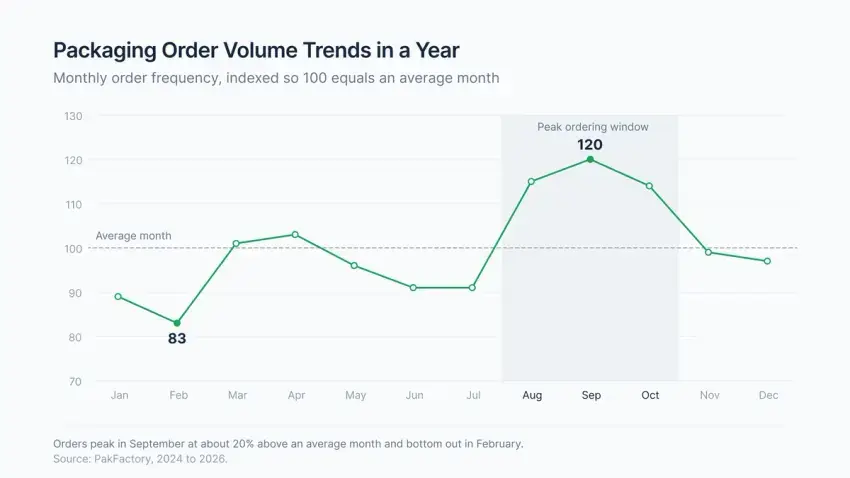

- Peak: September, running about 20% above an average month.
- Busy window: August to October. Volume builds through late summer and falls back to average in November.
- Quietest months: January and February.
That peak sits a season ahead of the shelf. Packaging ordered in September is product selling in November and December. The gap between the two is production and shipping, which is what the rest of this guide measures.
January and February are quiet for two reasons. Q4 packaging was ordered months earlier, so the year's largest seasonal programs are already in production or already delivered by the time January starts. And Chinese New Year falls in this window, closing most factories for about two weeks, so a project starting in January can face production delays.
Understanding Custom Packaging Lead Time
Lead times are quoted from pre-press approval, not from your purchase order. Design, dieline, proofing, color sign-off, and revision rounds all happen before that point. They are additional to the quoted number.
A complete seasonal packaging timeline has three stages:
- Design to approval: one to two weeks, or roughly 3 days with a print-ready file.
- Production: 18 to 45 business days depending on packaging type.
- Shipping: 2 to 65 days depending on method.
Add whatever time you need the stock on shelf before the occasion on top of all three.
Production Time by Product (Business Days)
Design and Approval Time
One to two weeks typically. Roughly 3 days with a print-ready file.
The timing depends in part on whether the artwork is ready for review or still needs design work.
The 3-day path only applies to a file that is genuinely print-ready, not simply supplied. Prepress still validates the dieline, checks bleed and safe zones, and confirms color. A file that fails those checks costs more time than designing from scratch, because the revision loop then sits with your designer rather than ours.
If you are supplying artwork, our guides to what a dieline is and how to prepare dielines for print cover what we check. Pantone matching is the other common gate, and some packaging types quote their lead time from Pantone confirmation rather than from pre-press approval.
How a New Structure Changes the Packaging Design Process
A new structure adds a dieline and a sample round before production starts. An existing structure skips both.
Plenty of brands build seasonal packaging in a completely different format from their core line, and when there is time for it, that is usually the version that stands out most. Our guide to creating packaging for limited-edition products covers what makes a drop feel distinct.
What a new structure adds:
- A new dieline. Drawn and validated before anything is printed.
- A new sample round. Produced and approved before production starts.
- Tooling, for some packaging types. Molded pulp adds 15 business days before production begins.
This is why the design stage runs one to two weeks against roughly 3 days for a print-ready file.
If your deadline is tight, running a structure you have made before is the faster path. The dieline exists, the sample is approved, and you are changing print rather than starting from a blank page.
If you have the runway, build whatever the season deserves. Reordering versus redesigning covers how to weigh it.
Shipping Time by Shipping Method
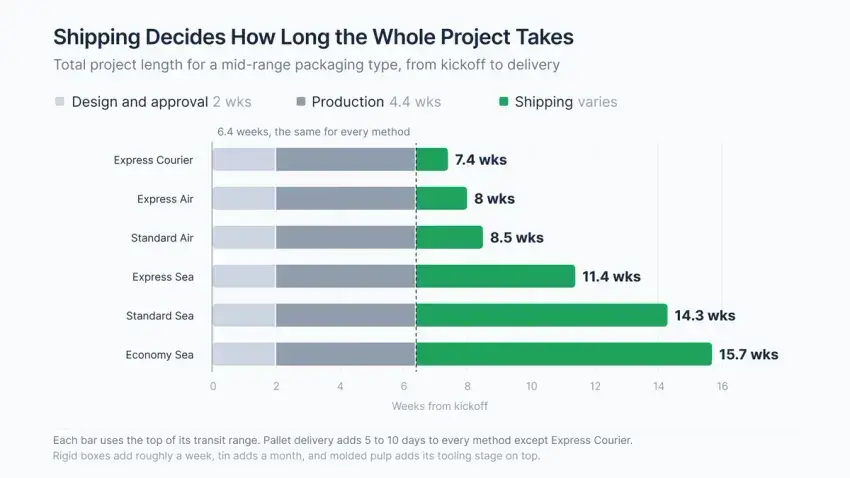
Shipping runs 2 to 65 days. The method you can afford is decided by when you order.
Recommendation: order early enough that sea freight is still an option. Starting late usually leaves air freight as the only way to hold the date.
How Does Chinese New Year Affect Packaging Production?
Chinese New Year 2027 falls on Saturday, February 6, and most factories close for about two weeks around it.
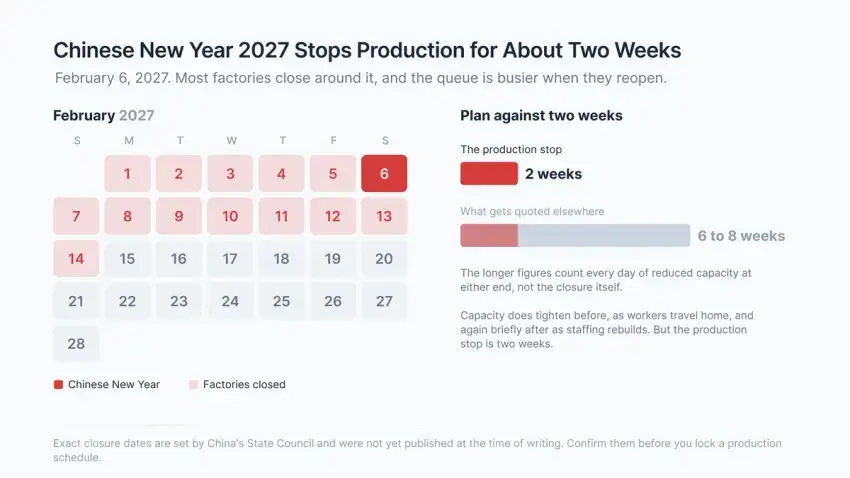
Plan against two weeks. You will see 6 and 8 week figures quoted elsewhere. Those count every day of reduced capacity at either end rather than the closure itself. Capacity does tighten beforehand as workers travel home, and again briefly afterwards as staffing rebuilds, but the production stop is two weeks.
A run that would have been in production during the first half of February is not. The queue it rejoins is busier than the one it left.
Easter and Mother's Day are the two 2027 packaging occasions this lands on. Order either at the deadline in the table below and production falls in or just after the closure, so order earlier if you can, or expect a slower queue than the dates suggest.
Two other periods stop production for a week or more:
- Labour Day Golden Week, from May 1.
- National Day Golden Week, from October 1.
Both typically run 5 to 8 days off. Several shorter public holidays, including Qingming in early April, Dragon Boat in late spring, and Mid-Autumn in September, cost a few days each rather than a week.
Confirm the dates before you lock a production schedule. China's State Council publishes the official holiday schedule, including which weekends are worked to extend each break, in November or December of the preceding year.
Illustrative 2027 Seasonal Order Dates
Order by August 19, 2027 for Q4 2027 by sea freight, or September 30, 2027 by air. Every other 2027 occasion is below.
How to Calculate Your Own Order Deadline
If your packaging type differs from the assumptions above, work backwards:
On-shelf date − shipping time − production time − design and approval time = your order-by date.
Total project length, for a mid-range packaging type:
Rigid boxes add roughly a week. Tin adds a month. Molded pulp adds its tooling stage on top.
Confirm Your Seasonal Delivery Schedule
Work back from the date the product needs to be on the shelf. Allow separate time for artwork approval, sampling, production and transit.
Talk to our team about your 2027 seasonal packaging. Ask for a sample on the actual board before you commit to a run.
Sources
- Chinese New Year 2027 begins on Saturday, 6 February 2027: Farmers' Almanac, Chinese New Year 2027: February 6, Year of the Goat.
Frequently asked questions
When do I need to order my 2027 holiday packaging?
Order by August 19, 2027 for standard sea freight, or September 30, 2027 for air. This assumes a mid-range packaging type delivered by US Thanksgiving on November 25. Rigid boxes add about a week and tin adds a month. Those dates cover design, approval, production, and shipping, so add any time you need the stock on shelf beforehand.
How long does custom packaging take to produce?
Between 18 and 30 business days for most packaging types, measured from pre-press approval rather than from your purchase order. Corrugated and folding carton sit at the fast end at 18 to 22 days. Tissue paper sits at the slow end at 25 to 30 days. Molded pulp adds a separate 15-day tooling step, and tin boxes sit well outside the range at 40 to 45 business days.
How does Chinese New Year affect packaging production?
Chinese New Year 2027 falls on February 6, and most factories close for about two weeks around it. Longer estimates of 6 to 8 weeks count reduced capacity at either end rather than the closure itself. Plan against the two weeks and expect a busier queue when production restarts.
What is the difference between air and sea shipping for packaging?
Speed against planning horizon, across 6 methods. Express Courier runs 2 to 7 days and air runs 7 to 15 days, both suited to time-sensitive work or recovery from a missed date. Sea runs 25 to 65 days depending on the service. Palletized delivery adds 5 to 10 days to everything except Express Courier.
Is there a minimum order for a seasonal run?
There is no order minimum. Base the quantity on the units you expect to sell during the promotion.
When is the busiest time for packaging manufacturers?
Late summer through autumn, peaking in September at about 20% above an average month. January and February are the quietest, because Q4 packaging was ordered months earlier and Chinese New Year closes factories in that window.
Original article by
5+ years in content strategy — building packaging case studies, guides, and blogs.