Original article and byline published by PakFactory.
Key takeaways
E-commerce packaging is specified from the product outward: board grade decides whether it survives transit, dimensions decide your freight bill, and the packaging type decides what the customer gets.
- 01A box rated 200# Mullen or ECT-32 carries up to 65 lb of contents.
- 02Since 18 August 2025, FedEx and UPS round every fractional dimension up to the next whole inch.
- 03The National Retail Federation forecast that 19.3% of online sales would be returned in 2025.
- 04If your pack will ship through Amazon, confirm the program requirements for your product and marketplace before ordering tooling.
- 05Minimum order quantities vary by packaging type and by supplier, so confirm them early.
Last updated October 2026.
What Counts as E-commerce Packaging?
E-commerce packaging ships directly to a customer without an outer carton protecting it. It absorbs the sorting, stacking, and drops of the parcel network on its own, which is the structural difference from retail packaging that travels to a store inside a larger case.
That difference shows up in the damage data. A Harris Poll survey of 3,071 US adults for DS Smith, fielded 7 to 11 November 2024, found 60% had received damaged goods ordering online that year. Among them, 32% reported the product was smashed inside its packaging, rather than the outer box simply being crushed or torn. That 32% is a specification failure, not a courier one.
It compounds with returns. The National Retail Federation and Happy Returns forecast that 19.3% of online sales would be returned in 2025, with retailers estimating that 15.8% of their own annual sales would come back across all channels. Every avoidable damage return costs you the outbound freight, the return freight, the replacement unit, and the margin on all three.
Choosing Your Packaging Type
3 types cover most e-commerce orders. The choice follows from weight, fragility, and whether the packaging needs to do brand work as well as protect.


Poly mailers are specified by thickness in mils (1 mil = 1/1000th of an inch). 2 mil is the common default for apparel and soft goods. Move up to 3 or 4 mil for anything heavy, dense, or with a corner that can work through the film. Going thicker than the product needs adds weight to every parcel you ship, so it is not a free safety margin.
Check each supplier’s minimum order policy and setup charges. EcoCustomPack offers every category with no minimum, so you can compare styles at the quantity you actually need.
One specification rarely serves a whole catalog either. If your products split across weight classes or fragility, specify more than one, because running the heaviest-duty box across every order means overpaying on the light ones.
Board Grade: The Number to Put on Your Quote
This is the spec that decides whether the box holds, and the one first-time buyers most often leave out of a quote request.
Corrugated board carries a strength rating from one of two tests. Mullen, or burst test, measures the force needed to rupture the face of the board, written as a pound figure like 200#. Edge Crush Test (ECT) measures edgewise compression strength, written as ECT-32. The two are not the same measurement, but converters publish equivalence tables that map them onto each other for practical purposes:
One caveat on reading across that table. The figures are the weight the box is rated to hold, not the weight of the finished parcel, and the Mullen-to-ECT equivalences are a converter convention rather than a published standard. They vary: 125# to ECT-23 and 200# to ECT-32 are consistent across every table we checked, while the rows between and above them are not, with some converters mapping ECT-29 to 150# and ECT-40 to 275#. That is the practical argument for what this section is telling you to do. Name the test and the number on your quote, because 200# and ECT-32 are not interchangeable by definition.
Which test to ask for matters. Mullen ratings require a minimum board basis weight, while ECT does not, so an ECT-rated box can hit the same performance using less material. That cuts your material cost on every order, and on parcels billed by actual weight rather than volume, the freight too.
Flute is a separate spec from strength. It is the wave of paper between the liners, and it sets thickness and print quality rather than rated load. E-flute is thinner and gives a smoother surface that holds fine print, which suits mailer boxes where the exterior is doing brand work. B-flute is thicker, cushions more, and stacks better, which suits shipping boxes carrying weight.
Ask for the flute and the rated load together. A strength claim with no named test behind it gives you nothing to hold a supplier to on the reorder.
What the Box Costs You to Ship
For anything light relative to its size, carriers bill on volume rather than weight. That is dimensional weight, and an oversized box costs you on every order rather than once.
One rule change makes this urgent. Since 18 August 2025, FedEx and UPS round every fractional package dimension up to the next whole inch before calculating dimensional weight, which added 5% to 12% to billed weight across typical parcel portfolios. A box measuring 12.4" on its longest side is now billed at 13". Nobody's box changed.
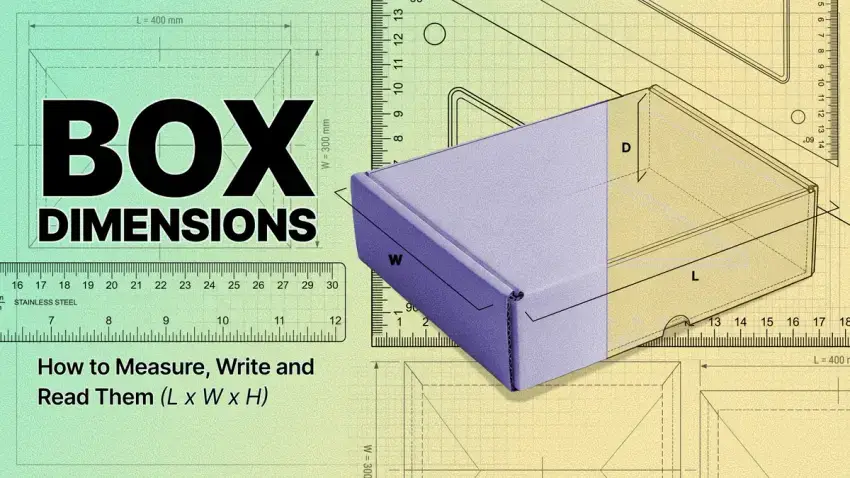
Two consequences worth designing around: cut the void space to the product plus its protection, and specify whole-inch dimensions wherever the product allows it, because a fraction of an inch is now charged and delivers nothing. Getting this right starts with measuring correctly, which we cover in our guide to measuring a box dimension.
Printing: Digital, Offset, and Flexo
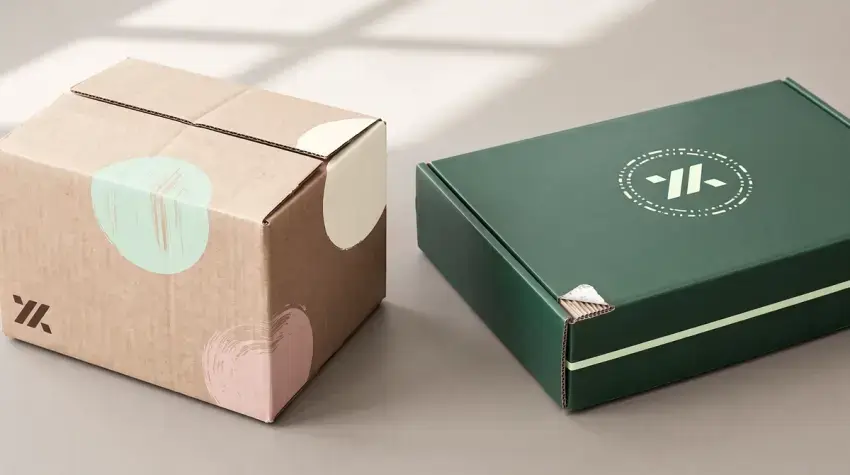
The print method is decided by quantity, not by quality preference. Digital printing uses no plates, so it is the economical route for low volumes and for any design you expect to revise. Offset printing carries a plate cost per design but drops in unit price as the run grows, and it is the usual route for designs that need foil stamping, embossing, or spot UV. Flexographic printing runs ink straight onto corrugated board at speed, which suits solid colors and line work rather than fine detail. The crossover point is specific to the design and the quote, so ask for prices at your actual order quantity rather than assuming one method is cheaper.
One thing worth knowing before you brief artwork: full-color graphics on corrugated are usually not printed onto the board at all. They are printed onto a coated paper sheet that is then laminated on, a process called litho-lamination. It is closer to a wrap than a direct print, and it is why a premium mailer box holds photographic detail a stock shipping box does not. Interior print is a separate line item on either route rather than something included by default.
Packaging for Amazon fulfillment
Decide whether the product will ship in its retail packaging or in a separate shipping box. That choice affects the outer board, closure, label panel and testing plan.
For an Amazon shipment, check the current seller guidance for the product, marketplace and fulfillment method. Confirm pack dimensions, labeling, prep and eligibility before you approve the structure.
Ask your fulfillment contact which test and documentation apply to the packed product. Provide the weight, dimensions, fragility and proposed closure before preparing samples.
Try the opening sequence on a packed sample. Check that buyers can remove the item without damaging it, and that the closure remains secure during transit.
Sustainable E-commerce Packaging
Right-sizing is the sustainability move with the shortest payback, because it cuts material, dimensional weight, and void fill in the same change.
After that, the choices that hold up are uncoated or recycled corrugated board, water-based or soy-based inks, and paper-based void fill in place of plastic. Our guide to eco-friendly packaging materials covers the substrate options in detail. Film lamination is worth naming specifically: it is a common reason an otherwise recyclable box cannot be recycled, and on an e-commerce pack it is usually buying a gloss the customer sees once.
Certification separates a claim you can make from one you cannot. Request the current documentation for the exact material, production site and intended use before specifying a certification.
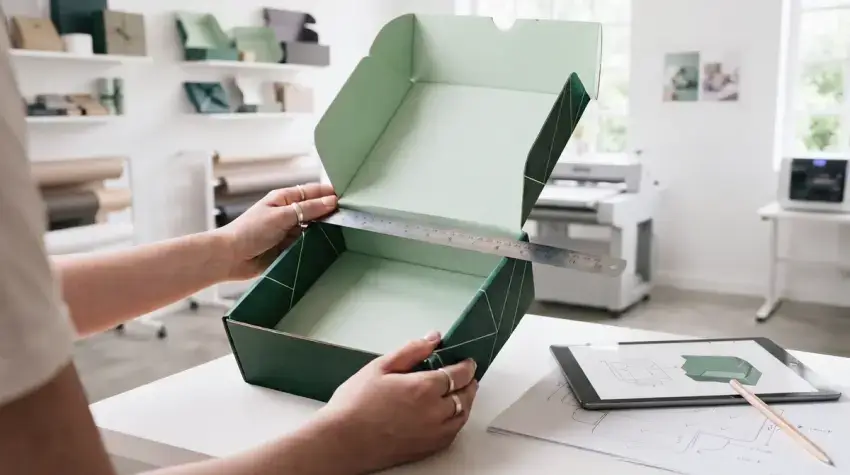
We make custom e-commerce packaging: mailer boxes, corrugated shipping boxes, poly mailers, and the die-cut inserts that go inside them. Tell us what you ship, how much of it, and where it goes. We will specify the packaging type, board grade, and insert for it. Talk to our team about an e-commerce packaging specification, and request a sample so you can handle the box before you commit to a run.
Sources
- Return rates: National Retail Federation and Happy Returns, 2025 Retail Returns Landscape, published 15 October 2025. Both figures are forecasts for 2025 rather than measured outcomes.
- Damage rates: The Harris Poll for DS Smith, fielded 7 to 11 November 2024, reported by Chain Store Age. DS Smith's own newsroom page no longer resolves following the International Paper acquisition.
- Board strength ratings: Crown Packaging, Mullen Test vs. Edge Crush Test Boxes: A Comprehensive Comparison. Equivalences cross-checked against Northern Container and CS Packaging; the 125# and 200# rows are consistent across all three.
- Dimensional-weight rounding change: Rickey DuBois, One Year Later: How the Dimensional Rounding Change Has Impacted the Parcel Industry, PARCEL Industry, 29 April 2026. The 5% to 12% range is attributed there to the 2025 Parcel Carrier Rate Impact Report.
- Amazon sellers can check the packaging program guidance in their seller account for the marketplace and product in question.
Frequently asked questions
What is e-commerce packaging?
Packaging that ships directly to a customer without an outer carton protecting it. It absorbs the sorting, stacking, and drops of the parcel network on its own, so it needs more structural strength than retail packaging that travels inside a larger case.
How is e-commerce packaging different from standard retail packaging?
Retail packaging is built to sell on a shelf and ships to the store inside a case. E-commerce packaging travels alone and has to protect the product across the full delivery journey, so strength ratings and dimensions matter more than shelf styling.
What packaging is used in e-commerce?
Mainly 3 types: mailer boxes for retail and subscription products, corrugated shipping boxes for heavier or multi-item orders, and poly mailers for apparel and other soft goods that cannot break.
What box strength do I need?
Match the rating to the weight of the contents, not the weight of the finished parcel. A 200# Mullen or ECT-32 single-wall box carries up to 65 lb of contents, which is the one pairing every published equivalence table agrees on. Table 2 in this guide gives the fuller range. Ask for the rating in writing rather than a description like "heavy duty."
How do I reduce dimensional weight charges on e-commerce packaging?
Size the box to the product plus its protection, and specify whole-inch dimensions where you can. Since August 2025 both FedEx and UPS round each fractional dimension up to the next whole inch, so a fraction of an inch is charged and delivers nothing.
Which packaging requirements apply to my Amazon order?
Check the current guidance in your seller account for the product, destination and fulfillment method. Confirm any labeling, prep, testing and documentation requirements before approving production.
Original article by
5+ years in content strategy — building packaging case studies, guides, and blogs.