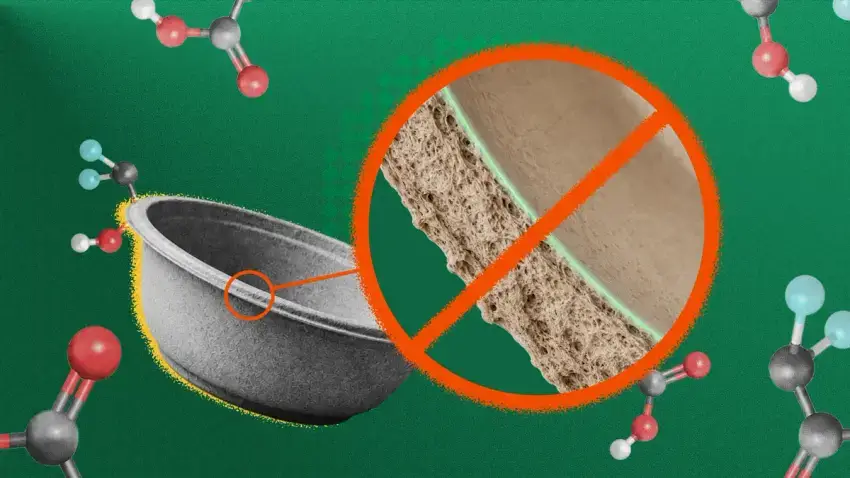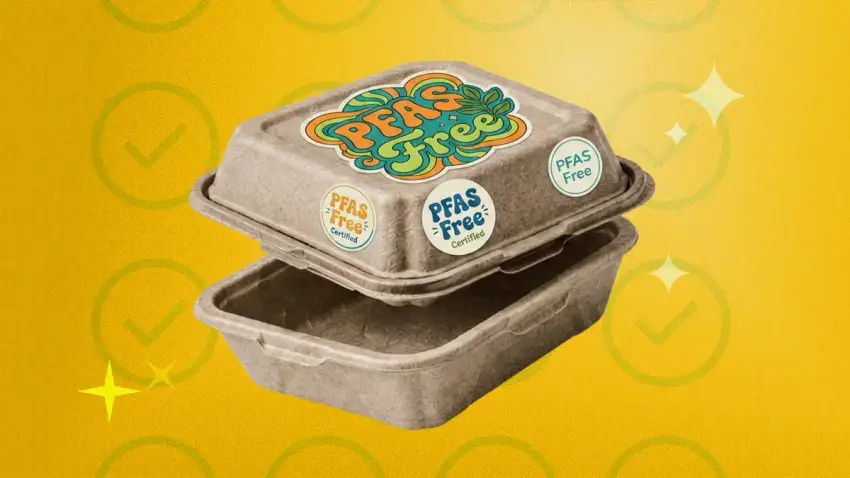
Original article and byline published by PakFactory.
Key takeaways
To prove your packaging is PFAS-free, pair a signed supplier declaration with an accredited-lab test, and match the certificate to your market's limit.
- 01As the importer, your brand carries the PFAS liability, not the overseas factory.
- 02A supplier's "PFAS-free" claim isn't proof on its own; a lab test is.
- 03Screen with a low-cost total organic fluorine (TOF) test; add a targeted LC-MS/MS test only for the EU or high results.
- 04Test at an ISO/IEC 17025 lab that covers PFAS and your material type.
- 05Match the certification to your market: under 50 ppm TOF for most (per NSF 537), 25 ppb per substance for the EU.
- 06A valid Certificate of Analysis names the method, result, and accredited lab; keep records on file — five years is a sensible default.
Start with the exact material and application. Ask the laboratory which test method, reporting limit and sample preparation fit your procurement specification.
PFAS (per- and polyfluoroalkyl substances, the "forever chemicals") are a large family of synthetic chemicals used since the 1940s to make products resist grease, water, and heat. They barely break down, so they build up in people and the environment over time, which is why regulators are restricting them in food packaging (US EPA: PFAS Explained).
How Do You Know If Your Packaging Contains PFAS?
PFAS turn up most in grease- and water-resistant paper and fiber food packaging, where they're added to stop oil and moisture soaking through. If your packaging is fiber-based and touches greasy or wet food, treat it as at-risk until it's tested (NIH).
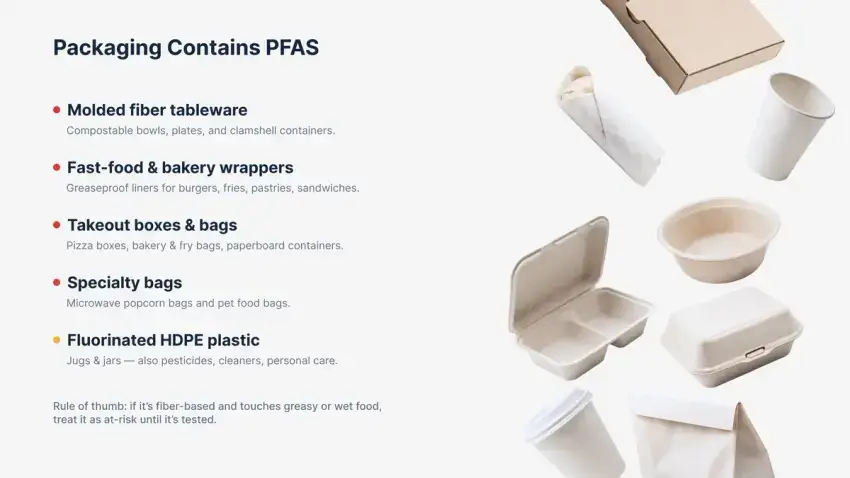
The usual suspects (fiber-based food packaging):
- Molded fiber tableware: compostable bowls, plates, and clamshell containers.
- Fast-food and bakery wrappers: greaseproof liners for burgers, fries, pastries, and sandwiches.
- Takeout boxes and bags: pizza boxes, bakery bags, french-fry bags, and paperboard takeout containers.
- Specialty bags: microwave popcorn bags and pet food bags.
Beyond fiber — treated plastic containers. Fluorinated HDPE jugs and jars (plastic treated with fluorine gas for a stronger barrier) can also form and leach PFAS, and these are used well past food, in pesticides, household cleaners, and personal-care products (EPA). So while the risk is concentrated in food-contact fiber packaging, a fluorine-treated plastic container is worth checking too.
Note the timing: in 2024 the FDA secured a market phase-out of grease-proofing PFAS in new US food packaging, with a June 30, 2025 compliance date to exhaust existing paper-packaging stock (FDA; Morgan Lewis). Even so, legacy stock, imports, and non-food fluorinated plastics mean verifying your own SKUs is still on you.

The Step-by-Step PFAS Testing Process for Brands
The process is a short, repeatable sequence that moves your packaging from "unverified" to "documented." It works whether you manage one supplier or many.
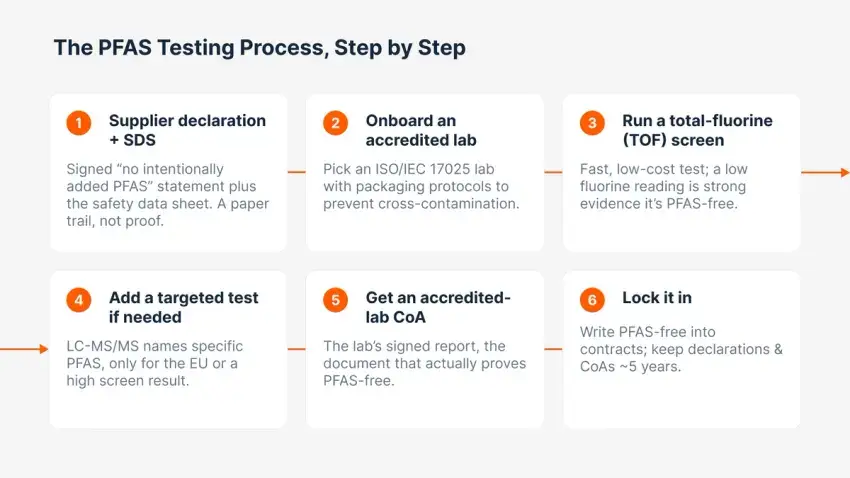
- Get a supplier declaration and safety data sheet (SDS). Ask each supplier for a signed statement of no intentionally added PFAS, plus the SDS, the standard document listing what is in a material. This is your paper trail, not your proof.
- Onboard an accredited laboratory. Before sending out samples, select a third-party laboratory certified in consumer product testing (such as ISO/IEC 17025 accreditation). Ensure they have specific protocols for handling packaging materials to prevent cross-contamination during transit and testing.
- Run a total organic fluorine (TOF) screen. TOF is a fast, relatively inexpensive lab test that measures how much fluorine is in the material; because PFAS are the usual reason packaging would contain fluorine, a low reading is strong evidence it is PFAS-free (Measurlabs).
- Add a targeted PFAS test only if you need it. If you sell into a market with per-substance limits (the EU) or the screen comes back high, run a targeted analysis (LC-MS/MS) that names and measures specific PFAS (Bureau Veritas).
- Get an accredited-lab Certificate of Analysis (CoA). The CoA is the lab's signed report of what was tested, how, and what was found. It is the document that proves your packaging is PFAS-free, matched to the rule of the market you sell into.
- Lock it in. Write PFAS-free into your supplier contracts and keep the declarations, CoAs, and test reports on file. As a best-practice default, hold them for at least five years so you can produce proof for a customs check, audit, or regulator on demand.
Total Fluorine vs. Targeted PFAS Testing: Which Do You Need?
Use the two tests for different jobs — pick by where you sell and what your screen shows:
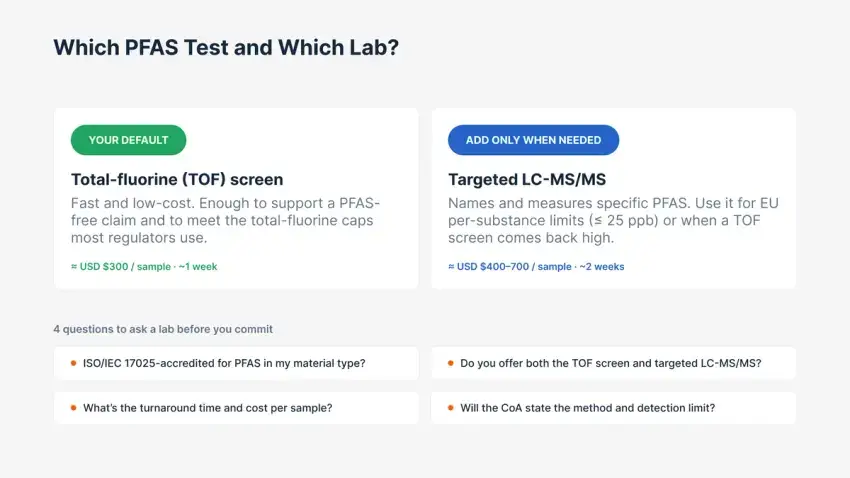
- Total organic fluorine (TOF) screen — your default. Fast and low-cost; enough to support a PFAS-free claim for most packaging and to meet the total-fluorine caps many regulators use.
- Targeted LC-MS/MS test — add it only when you have to. Namely, if you sell into a per-substance-limit market like the EU (≤25 ppb per substance), or if a TOF screen comes back high and you need to confirm whether that fluorine is actually PFAS.
The technical details of how each test works live in the FAQ, so you don't have to be a chemist to make the call.
Where to Test for PFAS: Choosing an Accredited Lab
Use a laboratory accredited to ISO/IEC 17025, the international standard that certifies a lab is technically competent and its results are trustworthy (ISO). Then confirm two things: that PFAS testing and your specific material type (paper and board, coatings, or plastics) are both inside that accreditation. Established third-party labs include Eurofins, SGS, Intertek, Bureau Veritas, UL, and NSF.
A short checklist to send a lab before you commit:
- Are you accredited to ISO/IEC 17025 for PFAS in my material type?
- Do you offer both the total organic fluorine screen and targeted LC-MS/MS?
- What is the turnaround time and cost per sample?
- Will the Certificate of Analysis state the method and detection limit?
Ask the proposed laboratory to confirm that its accreditation covers the material and test method specified in your brief.
Recognized PFAS-Free Certifications and What Their Thresholds Mean
Here is the honest read before the numbers: there is no single, universal "PFAS-free" stamp. The credible programs all land on the same idea, a total-organic-fluorine limit plus "no intentionally added PFAS," so the real question is not which logo to chase, it is which limit your market and your claim require.
For most food packaging, staying under roughly 50 ppm total organic fluorine with no intentionally added PFAS is the practical bar. If you sell into the EU, you need more: a targeted, accredited-lab test showing 25 ppb or less per substance. And a bare "PFAS-free" label with no threshold or test behind it is not proof of anything. Pick the certification that matches where you sell, and always ask for the Certificate of Analysis.
The programs, from strictest limit to most permissive, for reference:
How to Read a PFAS Certificate of Analysis
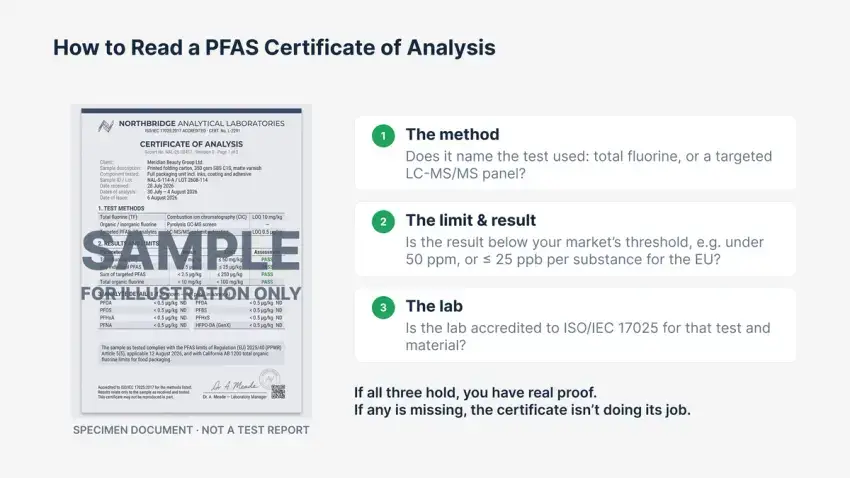
A Certificate of Analysis can look intimidating, but you only need to check three things:
- The method. Does it name the test used (total organic fluorine, or a targeted LC-MS/MS panel)?
- The limit and result. Is the result below the threshold your market or certification requires (for example, under 50 ppm, or 25 ppb per substance for the EU)?
- The lab. Is the lab accredited to ISO/IEC 17025 for that test and material?
If all three hold, you have real proof. If any is missing, the certificate is not doing its job.
Confirm the testing and documentation required for the exact finished packaging before ordering.
Collect the supplier declaration and laboratory report for the specific material or finished construction under review.
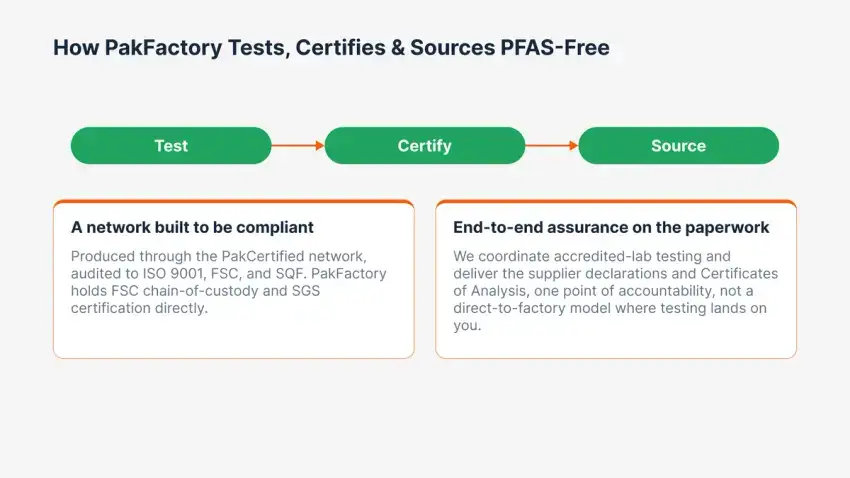
A network built to be compliant.
Request the current documentation for the exact material, production site and intended use before specifying a certification.
End-to-end assurance on the paperwork.
Check the sample identifier, test date, method and reporting limits before relying on a laboratory report.
Ready to check your exposure?
For a purchase specification, record which documentation applies to each SKU, destination and intended use.
Sources
- PFAS overview and carbon-fluorine bonds: US EPA — PFAS Explained.
- Accredited-lab standard: ISO/IEC 17025.
- Testing methods (TOF, targeted LC-MS/MS): Measurlabs; Bureau Veritas.
- Certification thresholds: BPI, NSF 537, UL Solutions, Intertek PFAS-Free.
- Paper-based food-contact materials method comparison: PubMed.
- Regulations: EU Packaging and Packaging Waste Regulation (PPWR) — Regulation (EU) 2025/40 (PFAS limits apply 12 Aug 2026).
- PFAS in food packaging (why and where): NIH — PFAS in Food Packaging: A Hot, Greasy Exposure.
- FDA grease-proofing phase-out (2024): FDA phase-out summary.
- PFAS in fluorinated plastic containers (non-food): US EPA — PFAS in Pesticide and Other Packaging; EDF — Beyond paper.
- NSF — Introduces PFAS-Free Certification (NSF 537 definition)
- FDA — Market Phase-Out of Grease-Proofing Substances Containing PFAS
Frequently asked questions
What types of packaging contain PFAS?
PFAS are most common in grease- and water-resistant paper and fiber food packaging: molded fiber tableware (bowls, plates, clamshells), fast-food and bakery wrappers, takeout boxes and bags (pizza boxes, french-fry bags), and specialty bags like microwave popcorn and pet food bags. They also appear in fluorinated HDPE plastic jugs and jars treated with fluorine gas, which are used beyond food (pesticides, cleaners, personal-care). If your packaging is fiber-based and contacts greasy or wet product, or is a fluorine-treated plastic container, treat it as at-risk until tested.
What is PFAS-free packaging?
PFAS-free packaging is packaging that contains no intentionally added PFAS and tests below a total-organic-fluorine threshold (commonly ≤50 ppm, or ≤25 ppb per substance for the EU). The claim only holds if it's backed by an accredited-lab Certificate of Analysis — a "PFAS-free" label with no test behind it isn't proof.
How do you test for PFAS in packaging?
In two tiers. First, a total organic fluorine (TOF) screen at an accredited lab measures the fluorine in the material as a fast proxy for PFAS. If you sell into a market with per-substance limits or the screen is high, you add a targeted LC-MS/MS test that names specific PFAS. An ISO/IEC 17025-accredited lab issues a Certificate of Analysis as proof.
How much does PFAS testing cost?
It varies by lab, method, and turnaround, but as a rough guide a total organic fluorine screen typically runs a few hundred dollars per sample, while targeted LC-MS/MS analysis usually costs about $400–$700 per sample and takes longer — often a couple of weeks (VIS Quality Control). Screen first for a fast, low-cost check and confirm with a targeted test only when needed. Always ask for a per-sample quote and confirm PFAS is within the lab's ISO/IEC 17025 scope.
What is total organic fluorine (TOF)?
It is the amount of organic fluorine in a material, measured by burning a sample and detecting the fluorine released. Because PFAS are built on carbon-fluorine bonds, fluorine is a reliable shortcut for detecting PFAS, which is why certifications set their limits in TOF. Most programs consider under 50 ppm (parts per million) a pass.
Is there a PFAS-free certification?
There is no single universal one, but several credible programs certify packaging as PFAS-free, including NSF 537, UL 746G, Intertek PFAS-Free, and BPI for compostables. They mostly set a total organic fluorine limit (roughly 20 to 100 ppm) plus "no intentionally added PFAS." Choose the one whose limit matches where you sell.
Does a clean total-fluorine screen guarantee compliance?
Not everywhere. A low total organic fluorine result supports a PFAS-free claim and meets the total-fluorine caps some regulators use, but it does not by itself prove compliance with per-substance limits like the EU's 25 ppb. Targeted panels also cover a set list (often 20 to 40 compounds), so "none detected" is not the same as "zero PFAS." When in doubt, confirm with a targeted test.
Original article by
5+ years in content strategy — building packaging case studies, guides, and blogs.