Original article and byline published by PakFactory.
Key takeaways
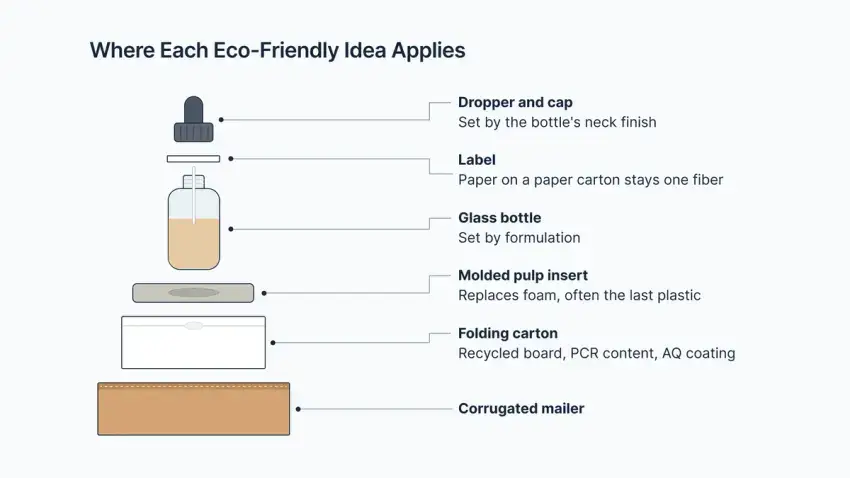
Sustainable cosmetic packaging is mostly decided outside the bottle: the carton, the insert, the label, and what they claim.
- 01A beauty brand's bottle or jar is usually fixed by formulation and fill-line compatibility.
- 02The carton, insert, and label are the layers a cosmetics brand actually specifies.
- 03Composters cannot accept the bioplastic PLA and keep organic certification for their output, per Packaging Dive.
- 04California requires written records behind an environmental claim, available to the public on request.
- 05The FTC's Green Guides, last revised in 2012, require environmental claims to be substantiated nationally.
Most eco-friendly cosmetic packaging lists open with the bottle, which is the one part a beauty brand usually cannot change. 3 things settle a container's specification before the packaging brief exists: the formulation inside it, the barrier that formulation needs, and the filling line already running the SKU.
None of those factors dictate the carton, insert, or label. That secondary packaging is precisely where eco-friendly cosmetic decisions take shape, and it is the focal point of all seven ideas below.

1. Recycled Paperboard Cartons
Swap coated white board for an uncoated recycled grade or natural brown kraft. This is the largest printed surface in most cosmetics packaging and the easiest item on this list to change, because it needs no new tooling and no structural redesign.
Both grades take print well enough for beauty, and both keep the carton in a single fiber. That matters more than the recycled percentage does: cosmetic product packaging made of one material goes into paper collection as it is, while a carton built from two has to be separated first.
Cosmetic packaging for small businesses gains the most here. A small brand usually buys a stock container from a filler's catalog, so the carton is where nearly all of its decisions live. It is also the layer that does not touch a filling line, which makes it the least expensive layer to change.
2. Post-Consumer Recycled (PCR) Content
Ask for a stated percentage, split post-consumer and pre-consumer, per component. PCR is material recovered from something a consumer used and threw away, so it describes what the packaging was made from. It describes nothing about what happens afterward.
Recycled content for personal care packaging and recyclability are separate properties: a carton at 100% PCR with a metallic film laminated over it has high recycled content and cannot be recycled. Both are worth specifying and neither substitutes for the other.
3. Molded Pulp Inserts
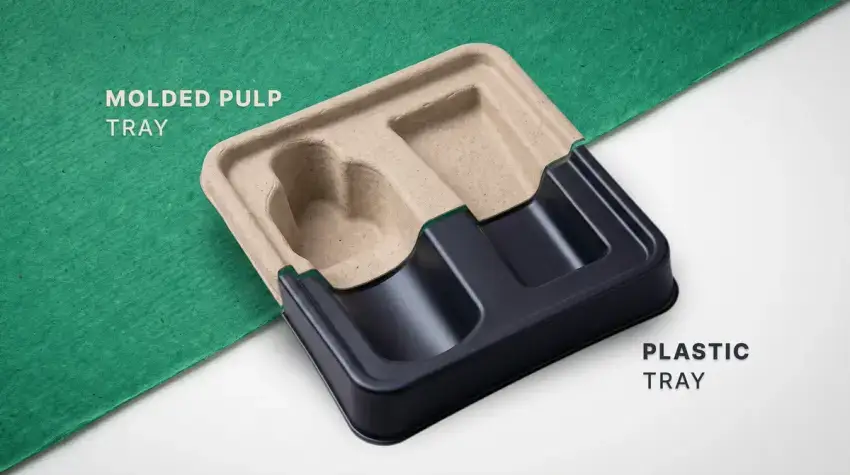
Replace foam inserts with molded pulp or die-cut cardboard. A carton can be recycled board with an uncoated finish and still hold a block of foam. The insert is usually the last plastic left in otherwise-paper packaging, and it is the component least often written into a specification.
Molded pulp can be produced from post-consumer waste pulp, so a single component arrives both recycled and recyclable. Die-cut cardboard is lighter again and suits flat items. Both hold a bottle at the shoulder firmly enough to stop it moving, which is what durable personal care packaging needs from an insert.
While foam remains necessary for protecting delicate pumps or heavy glass closures, substituting it with an unstable paper insert compromises protection regardless of spec sheet claims. Personal care packaging commonly suffers transit damage at the insert rather than at the outer carton. For a detailed breakdown of available formats and their respective trade-offs, consult our master guide to packaging inserts.
4. Water-Based Coatings in Place of Film Lamination
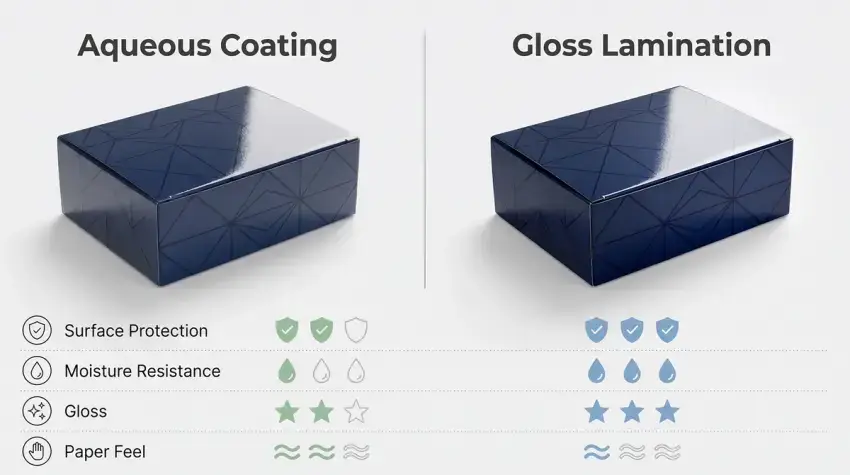
Specify an AQ (aqueous) coating rather than a gloss, matte, soft-touch, or metallic film lamination. A film lamination is a plastic layer glued over the print, and it is a common reason a cosmetics carton that looks like paper cannot be recycled as paper. An aqueous coating is water-based and pulps away with the fiber. The same logic applies to the brand mark: an emboss adds no material at all, only pressure, whereas hot foil adds metal.
5. Paper Labels
A paper label on a paper carton keeps the whole thing as one fiber. The label is a small component that decides a disproportionate amount, because it is both a material and the surface every printed claim sits on.
One note on what the label says. An environmental claim is a regulated claim. California's environmental marketing law requires anyone making one on a consumer good, recyclability included, to keep written records of why they believe it is true, and to furnish them to any member of the public who asks. The FTC's Green Guides, last revised in 2012 and under review since 2022, set the same expectation nationally. So the label decision and the claim decision are the same decision: if the carton says recyclable, somebody has to be able to show why.
6. Refillable Formats
Sell a refill in a pouch or a small carton and the container gets a second life. This is the only idea here that reaches the bottle, and it does so without changing the bottle. The customer keeps a container they already own and buys the contents again. That makes refills a format and business-model decision rather than a materials one. Two things have to hold: a refill that ships and stores well on its own, and a customer who returns for the second purchase. The first is straightforward and the second is the real test.
7. One Less Component
Take a part out. Sustainable skincare packaging carries more separate materials than most categories: a bottle, a pump, a carton, an insert, a leaflet, and sometimes a sleeve. That is up to 6 things to make, buy, ship, and account for. Removing one reduces material and cost together, which nothing else on this list does. A sleeve carrying copy that would fit on the carton is the usual candidate, as is a leaflet repeating what is already printed on the box.
It also matters under extended producer responsibility, or EPR, which makes producers financially responsible for the packaging they place on the market. 7 US states have enacted packaging EPR programs, with fees live in Oregon since July 1, 2025 and in Colorado since January 2026, and California's ongoing program fees beginning in 2027 (EPR Atlas). Those programs account for packaging material by material, so sustainable beauty packaging and eco-friendly skincare packaging work tends to go further when components are counted before materials are chosen. The mechanics and the state-by-state position are in our guide to extended producer responsibility for packaging.
Why Cornstarch, Seaweed, and Beeswax Are Not on This List
Cornstarch, meaning PLA. Polylactic acid is a plastic made from plant sugars, and it does break down in an industrial composting facility. Reaching one is the problem. Per Packaging Dive, US Department of Agriculture (USDA) rules say nothing put into compost can be synthetic, meaning composters that want to certify their product as organic cannot accept PLA. Collection is the other half of the problem: BioCycle's 2023 survey of residential composting systems found that only about 12% of US households had access to municipally supported curbside or drop-off food-waste collection. NatureWorks, the largest PLA producer, told the publication that "recycling isn't happening more broadly in the U.S. mostly due to scale."
Seaweed. Seaweed film is still in the prototyping phase and a material a brand cannot order is not an idea.
Beeswax. Beeswax wraps are a food-wrap product rather than cosmetics packaging, and the section recommending them cited a stock photo library.
None of this argues against compostable materials. It argues against claiming compostability as a benefit to a US customer.
What to Ask a Cosmetic Packaging Supplier For
5 asks, and they are not equally routine. Sustainable cosmetic packaging suppliers differ more in what they can document than in what they can produce. The first three below are standard practice and any supplier should meet them without discussion. The last two are newer, and how a supplier answers them is informative in itself.
- A physical pre-production sample, made on the actual board with the actual finish. Standard practice, and the most useful thing on this list. A recycled grade with an aqueous coating looks and feels different from a coated board with a film lamination, and no specification sheet settles that argument.
- The board specification, naming the grade, the weight, and the recycled content. Standard, and the document every later question refers back to.
- An FSC chain-of-custody certificate number from the company that converts your board, not a statement that a mill somewhere is certified. Standard, and the certificate number is verifiable in FSC's public database, which is the point of asking for the number rather than the logo. Our guide to FSC certified packaging covers what it does and does not prove.
- Third-party verification of a recycled-content percentage, where the percentage is going to be printed or quoted. A supplier's own declaration is the normal answer and it is a self-declaration. SCS Recycled Content Certification is the most direct route for paperboard; the Global Recycled Standard, the Recycled Claim Standard, and ISCC PLUS verify the same figure but are written around textile and chemical supply chains, so ask which one your converter actually holds. Asking is not yet common, and it is the difference between a number you have been given and a number you can stand behind.
- Written confirmation of any claim they will print for you. If a supplier is going to put "recyclable" or a chasing-arrows symbol on your carton, ask what they hold behind it. California already requires a written record behind an environmental claim, and a supplier who cannot answer before artwork approval will not have a better answer afterward.
Understanding Cost Factors. Respecifying packaging impacts cost across four key areas: board substitution, finish substitution, insert substitution, and certified stock selection. Additionally, molded pulp requires upfront tooling fees; because this one-time expense is amortized over the production volume, the per-unit cost difference is far more pronounced on a 2,000-unit run than on 50,000 units.
For a cosmetics carton, list the board, coating and insert separately. Ask which documents apply to the actual construction, then review a sample before changing materials.
Sources
- The requirement to keep written records substantiating an environmental marketing claim, and to make them available to any member of the public on request: California Business and Professions Code § 17580, in force since January 1996.
- The national expectation that environmental claims be substantiated: FTC, "Guides for the Use of Environmental Marketing Claims" (the Green Guides), last revised 2012 and under review since 2022.
- The USDA organic rule barring composters from accepting PLA, the 12% household food-waste access figure (originating in BioCycle's 2023 survey of residential composting systems), and the NatureWorks statement on scale: Packaging Dive, "Inside the debate over PLA, the packaging industry's favorite bioplastic", published October 8, 2024.
- US state packaging EPR programs and fee-live dates, confirmed as 7 enacted states with per-ton fees live only in Oregon and Colorado: EPR Atlas, EPR Laws by State.
- Third-party recycled-content verification: SCS Recycled Content Certification, SCS Global Services.
Frequently asked questions
Why Is Sustainable Packaging Important in Beauty Products?
Because packaging is most of what a beauty customer physically handles, keeps on a shelf, and eventually throws away, and because a growing amount of it is regulated. Beauty also runs more components per product than most categories, so the same decision repeats across a bottle, a carton, an insert, and a label rather than being made once.
What Is the Most Eco-Friendly Packaging for Cosmetics?
A carton made from one fiber, with no film laminated over it, holding an insert made from the same fiber. Single-material packaging is the simplest thing to claim and the easiest thing for a recycler to handle. Adding a second material is what turns a recyclable carton into a sorting problem.
How Do You Package Cosmetics for Shipping?
Put the product in a folding carton or rigid box, then inside a paper mailer or corrugated shipper. The insert does the work: a die-cut cardboard or molded pulp platform gripping the bottle at the shoulder holds it still without loose void fill, which removes a material from the packaging and a step from the pick line.
How Do You Recycle Cosmetics Packaging?
By component, because the components do not go the same way. A single-fiber carton with no film lamination goes into paper collection. A bottle or jar depends on its resin and on the program serving your customer. Pumps and droppers are mixed-material assemblies and are the hardest to place. Telling a customer to separate the carton from the container is a more useful instruction than a symbol.
How Do You Choose Label Material for Cosmetics Packaging?
Match the label to the surface it goes on, then check what it does at disposal. A paper label on a paper carton keeps everything in one fiber. A film label gives water resistance and wraps a curved container better, and adds a second material to packaging that was otherwise single-fiber. Where the label carries a recyclability claim, the material and the claim have to be decided together.
What Is PAO in Cosmetics Packaging?
PAO stands for Period After Opening. It is the open-jar symbol with a number and the letter M, indicating how many months a product stays usable after opening. It is a formulation claim rather than a packaging claim, which matters when asking a supplier what they can substantiate: the stability and preservative-efficacy data behind a PAO figure sits with the brand and its formulator, not with the company printing the symbol.
Original article by
5+ years in content strategy — building packaging case studies, guides, and blogs.